

IAP-26-049
Assessing the Vulnerability of Scotland’s Peatland Historic Environment under Future Climate and Restoration Scenarios
Scotland contains the largest extent of peatlands in the UK (ONS 2019) and these ecosystems are internationally important for carbon storage, biodiversity conservation and water regulation (Bain et al. 2011). They also represent some of Europe’s most significant cultural landscapes and environmental archives. The waterlogged, anoxic conditions characteristic of peatlands preserve archaeological features, organic artefacts, buried land surfaces and palaeoenvironmental records that rarely survive elsewhere, providing unique evidence for past environments, land use and human-environment interactions over millennial timescales (Mann 2022; Gearey and Chapman 2023).
However, many Scottish peatlands are already experiencing degradation through drainage, erosion, afforestation and historical land-use practices. Climate change is expected to intensify these pressures through increasing temperatures, altered hydrological regimes, drought and heightened wildfire risk, accelerating peat loss and compromising the long-term preservation of both ecological and cultural archives (Swindles et al. 2019). As peat dries, erodes or is lost, irreplaceable evidence of Scotland’s environmental and cultural past is increasingly at risk.
Despite major advances in peatland science, restoration ecology and climate-change research, understanding of the vulnerability of Scotland’s peatland historic environment remains limited. Although the archaeological significance of peatlands is widely recognised, substantial gaps remain in knowledge of the distribution, condition and climate sensitivity of archaeological and palaeoenvironmental archives preserved within peat deposits (Gearey et al. 2026). Scotland has internationally recognised expertise in peatland restoration and monitoring, yet lacks an equivalent evidence base for assessing how projected changes in peatland condition may affect the preservation of archaeological and palaeoenvironmental resources (Gardner 2022). Compared with Ireland, the Netherlands and parts of Scandinavia, there has been relatively little systematic assessment of climate-related risks to peatland heritage, and no climate-risk framework for the peatland historic environment.
This knowledge gap has important practical implications. Decisions concerning peatland restoration, land management, renewable-energy development and climate adaptation are increasingly being made at landscape scales, often within vulnerable peatland environments containing poorly documented archaeological and palaeoenvironmental resources. Historic Environment Scotland, ALGAO and peatland restoration communities have recognised the need for improved approaches to identifying vulnerable heritage assets and understanding how changing peatland conditions may affect their preservation. Yet there is currently no integrated framework combining climate projections, peatland condition and heritage significance to support strategic conservation planning.
This project will address this gap by developing and testing a framework for assessing the vulnerability of Scotland’s peatland historic environment under future climate and restoration scenarios. By integrating climate-risk assessment with archaeological and palaeoenvironmental assessment, it will provide the first systematic framework for evaluating future threats to Scotland’s peatland historic environment and an evidence base for conservation, monitoring and adaptation. The project will also establish scalable protocols for assessing vulnerable peatland landscapes using remote sensing and rapid assessment approaches to support decision-making in restoration, infrastructure and climate-adaptation projects.
The project therefore addresses two overarching research questions: (1) Which archaeological and palaeoenvironmental resources preserved within Scotland’s peatlands are most vulnerable to projected climate-driven changes in peat condition during the twenty-first century? (2) How can climate exposure, peatland condition and heritage significance be integrated into a national framework for identifying priorities for conservation, adaptation and monitoring?
These questions contribute to the overall aim of developing a scalable framework for assessing the vulnerability of Scotland’s peatland historic environment under future climate and restoration scenarios, with wider applicability beyond Scotland.
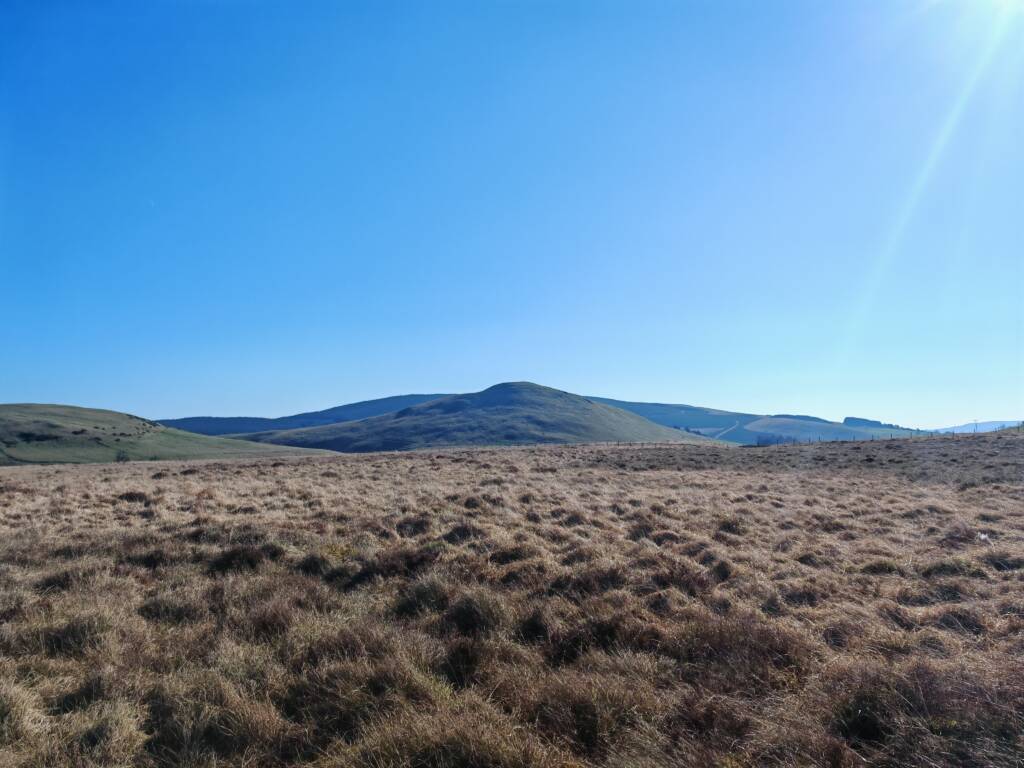
Click on an image to expand
Image Captions
Upland peat landscape, Glen Devon, Scotland, UK. Photo: Stuart Munro, RESPECT project
Methodology
The project will take a landscape case-study approach, with case studies selected by the PhD student, and follow several stages:
Stage 1: Literature review and synthesis current understanding of preservation requirements and threats, identifying conditions that preserve wood, leather, artefacts, palaeoecological archives and buried land surfaces. Review existing knowledge of peatland archaeology across Scotland and select case-study landscapes for further investigation.
Stage 2: Detailed investigation of three contrasting peatland landscapes combining remote-sensing, erosion, ecological and hydrological datasets, archaeological and palaeoenvironmental records. Selective geoarchaeological sampling and laboratory analyses (e.g. loss-on-ignition, carbon content and C14 dating) will provide indicative measures of peat condition, accumulation history and peat condition status to contextualise and validate landscape-scale vulnerability assessments. Datasets will be integrated within a GIS framework to identify patterns in peat condition, landscape stability and environmental change, and evaluate their influence on the preservation and exposure of archaeological and palaeoenvironmental archives across different peatland settings.
Stage 3: Establish future site exposure using UKCP18-derived variables and existing peatland vulnerability datasets. This will employ existing climate and peatland condition projections.
Stage 4: Develop and apply a heritage-risk index using hazard (climate change), exposure (peat condition and projected change), sensitivity (archaeology/archive type) and heritage significance to create a vulnerability matrix for the case studies, followed by identification of hotspots for intervention and adaptation. Sensitivity analyses will be used to evaluate the influence of different climate and peatland-condition scenarios on vulnerability assessments.
Stage 5: Evaluate implications for policy and mitigation within vulnerable peatland landscapes of historic-environment significance and develop recommendations for archaeological practice and assessment in large-scale peatland landscapes.
Case studies: The PhD student will select and refine a suite of case-study landscapes (extents to be determined) representing contrasting peatland types and conditions, ranging from relatively intact systems to degraded and actively restoring peatlands. This comparative approach will assess how climate change, peatland condition and restoration trajectories influence the vulnerability of archaeological and palaeoenvironmental archives.
Three broad peatland settings could be represented. First, northern blanket bogs (e.g. Flow Country) provide examples of extensive, relatively intact peatland systems where the archaeological resource remains comparatively under-synthesised, offering considerable scope for investigation. Atlantic and coastal peatlands (e.g. Western Isles, Argyll) contain exceptionally rich archaeological landscapes and palaeoenvironmental archives and are particularly vulnerable to coastal erosion, peat wastage, drought and wildfire, providing an opportunity to examine risks facing archaeologically rich but increasingly degraded peatland environments. Upland peatlands (e.g. Cairngorms or eastern Highlands) represent shallower, often fragmented systems subject to pressures including recreation, drying and wildfire. Many are also the focus of large-scale restoration efforts. Their archaeological and palaeoecological records provide an opportunity to examine how restoration trajectories may influence future preservation of peatland archives and heritage vulnerability. Together, these case studies would capture a broad spectrum of Scottish peatland environments and climate-change pressures, enabling development and testing of a vulnerability-assessment framework across contrasting ecological, archaeological and management contexts.
Project Timeline
Year 1
Stage 1 (M1-6): Literature review; preservation framework; case-study selection; research design.; write of these sections.
Stage 2 (M6-12): Dataset collation and cleaning; GIS database construction; archaeological dataset synthesis; preliminary landscape analysis; initial climate-exposure assessment. Secondment with JHI: 1 month
Fieldwork: Summer campaign – field ground truthing and removal of cores for laboratory analysis (3 weeks).
Year 2
Stage 2 (M13-19): Laboratory analysis and chronology development; GIS integration; case-study assessment; integrated landscape analysis; methods chapter. Secondment with JHI: 1 month
Writing (M20-24): Draft case-study chapters and results.
Year 3
Stage 3 (M25-28): Climate-exposure assessment.
Stage 4 (M29-34): Develop, test and refine heritage vulnerability framework.
Stage 5 (M33-36): Policy implications, adaptation recommendations and stakeholder evaluation (JHI, HES, NTS and others). Secondment with JHI: 1 month
Year 3.5
Discussion and synthesis (M37-40)
Thesis integration, revision and submission (M40-42)
Training
& Skills
The student will receive interdisciplinary training in geospatial technologies, environmental science and heritage management. This will include advanced GIS and spatial analysis, LiDAR and satellite remote sensing, drone-based survey (O’Driscoll), topographic and landscape-scale erosion analysis (Evans), geospatial modelling and database management (Ferrier, O’Driscoll, Evans, Whitehouse). Training will be provided in peatland science, geoarchaeological field and laboratory methods (Whitehouse, Evans), Bayesian age-modelling (Whitehouse) climate-risk assessment (Whitehouse, Ferrier, Evans), statistical analysis and stakeholder engagement (Evans, Whitehouse, O’Driscoll, Ferrier). This will create a diverse suite of technical, analytical and professional skills, equipping the student to work across the environmental science and heritage sectors.
Additional training and support in transferable skills will be available via the University of Glasgow and University of Durham, and the student will be expected to present their work annually at internal research seminars and undergo Annual Progress Review (APR) to ensure progression and supervision support. The student will attend training and networking events within IAPETUS DTP.
The student will spend a 3-month period secondment with the CASE Partner, James Hutton Institute, split across 3 trips in Years 1, 2 and 3 (Dundee and Aberdeen) to work with supervisor Ferrier, and develop collaborations and datasets with researchers at JHI.
References & further reading
Gardner, T. (2022). Peatland restoration and the historic environment in Scotland: a perceived climate/culture conflict. The Archaeologist 115 (Winter 2022), pp. 14–15. DOI: 10.11588/cifatamag.2022.115.87412
Gearey, B.R. and Chapman, H.P. (2023) An Introduction to Peatland Archaeology and Palaeoenvironments. Oxbow Books
Gearey, B., Gearey, R., Jennings, B. and van Beek, R. (2026) ‘Last chance to see? The “Crisis of Preservation” and pathways to a sustainable future for Europe’s peatland archaeology’, Antiquity, 100(409), pp. 182-195. https://doi.org/10.15184/aqy.2025.10255
Mann, B. (2022). Guidance for Peatland Restoration and the Historic Environment in Scotland (Version 1.1, March 2022). Association of Local Government Archaeological Officers (ALGAO) Scotland. Available at: ALGAO publication page. [algao.org.uk]
ONS (2019) UK Natural Capital Peatlands. Office for National Statistics, Statistical Bulletin https://www.ons.gov.uk/economy/environmentalaccounts/bulletins/uknaturalcapitalforpeatlands/naturalcapitalaccounts
Swindles, G.T., et al. (2019) Widespread drying of European peatlands in recent centuries, Nature Geoscience, 12(11), pp. 922-928. https://doi.org/10.1038/s41561-019-0462-z
