

IAP-26-074
Understanding and predicting the hydrological resilience of urban rain gardens under a changing climate
Urbanisation fundamentally alters the natural water cycle by replacing permeable landscapes with impervious surfaces, accelerating surface runoff and increasing the risk of surface water (pluvial) flooding. These pressures are expected to intensify as climate change influences rainfall patterns and the frequency and intensity of extreme precipitation events. Nature-based solutions, including Sustainable Drainage Systems (SuDS), offer opportunities to restore elements of natural hydrological functioning within urban environments through infiltration, water storage, evapotranspiration and the attenuation of stormwater runoff [1].
Rain gardens, also known as bioretention systems, are increasingly incorporated into urban drainage strategies to manage runoff from roads, pavements and other impervious surfaces. Their hydrological performance is governed by interactions between rainfall characteristics, antecedent moisture conditions, soil hydraulic properties, vegetation and subsurface drainage configurations[2]. Despite their increasing adoption, important uncertainties remain concerning the physical processes controlling water movement, storage and drainage, particularly under extreme rainfall and drought, successive storm events and changing environmental conditions. Furthermore, the extent to which hydraulic performance evolves over an asset’s operational lifespan and the implications for long-term resilience and maintenance requirements, remain insufficiently understood.
This PhD will investigate the hydrological processes governing the performance and functionality of urban bioretention systems through an integrated programme of controlled experimentation, continuous environmental monitoring and process-based numerical modelling.
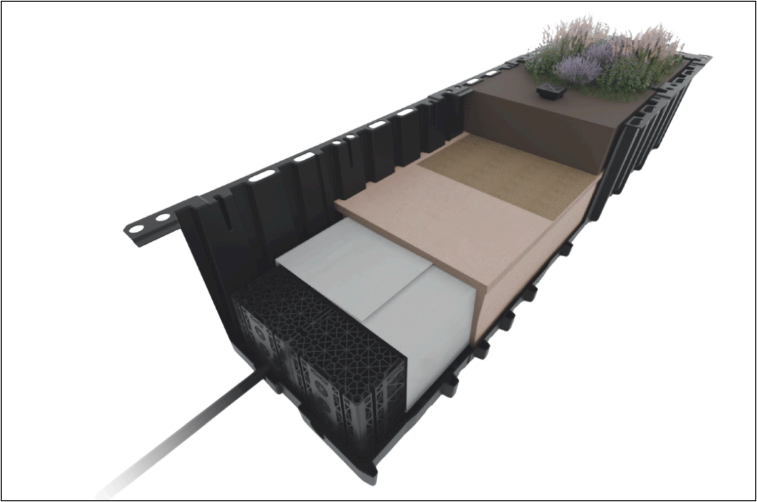
The research will utilise two newly installed and instrumented rain gardens at Durham University, developed in collaboration with CASE partner GreenBlue Urban. The systems comprise a conventional HydroPlanter and a HydroPlanter MAX[3] (Fig. 1), the latter incorporating additional engineered subsurface storage within a comparable surface footprint. Their contrasting configurations provide an opportunity to investigate how subsurface storage architecture influences infiltration, soil moisture redistribution, temporary water retention and discharge dynamics.
Controlled inflow experiments will simulate runoff generated by rainfall events of varying magnitude and duration, including extreme and successive storm events. Continuous measurements of inflow, outflow, soil moisture and environmental conditions will be used to characterise hydrological responses and quantify runoff attenuation, storage utilisation and drainage recovery. Standardised experiments will be repeated throughout the project at 6-monthly intervals to investigate temporal changes in hydraulic behaviour, identify potential mechanisms of performance degradation or improvement, and evaluate emerging maintenance requirements.
Experimental observations will inform the development, calibration and validation of numerical models to simulate variably saturated water flow through the bioretention media. The modelling framework will be used to investigate dominant hydraulic controls, evaluate parameter sensitivity and uncertainty and assess system responses across a wider range of rainfall scenarios and hydraulic conditions than can be reproduced experimentally. Particular emphasis will be placed on understanding how changes in hydraulic properties and subsurface storage availability influence hydrological performance over time.
The project will be undertaken in partnership with GreenBlue Urban, a specialist provider of urban green infrastructure and sustainable drainage solutions, with end-user involvement from Northumbrian Water. These collaborations support the translation of experimental and modelling findings into practical recommendations for the design, monitoring and maintenance of urban bioretention systems, contributing to more resilient and effective urban stormwater management.
Click on an image to expand
Image Captions
Figure 1: HydroPlanter schematic. Source: GreenBlue Urban.
Methodology
This PhD project will integrate continuous environmental monitoring and controlled inflow experimentation using two instrumented rain gardens at Durham University as experimental case studies. Process-based numerical modelling will complement the experimental programme, enabling the investigation of subsurface hydrological processes and the extrapolation of observed system responses to a wider range of rainfall conditions, hydraulic configurations and longer-term performance scenarios. The research will be structured around four interrelated work packages:
WP1: Baseline hydrological characterisation and monitoring. The physical and hydraulic properties of the bioretention media will be characterised, including soil texture, bulk density, saturated hydraulic conductivity and soil water retention characteristics. Existing monitoring infrastructure and as-built design information will support the assessment of soil moisture dynamics, environmental conditions, subsurface storage and drainage responses. Continuous monitoring and hydrological time-series analysis will be used to investigate seasonal variability, natural storm responses, antecedent wetness and drainage recovery. Repeated measurements of hydraulic properties will provide a basis for evaluating changes in system performance over time.
WP2: Controlled experimental investigation and hydraulic trends. Controlled inflow experiments[4] will simulate stormwater runoff generated from impervious catchments, under varying design storm magnitudes and intensities, building upon an established experimental protocol. Subsequent experiments will investigate contrasting antecedent moisture conditions, successive storm events and variable inflow hydrographs. Measurements of inflow, outflow and internal soil moisture will quantify runoff attenuation, hydraulic lag, transient water storage, drainage rates and recovery times. Comparative analysis of the two systems will investigate the influence of subsurface storage configuration on hydrological response and feed into informing future SuDS design specifications. Standardised experiments will be repeated throughout the project to assess temporal changes in hydraulic performance and investigate potential mechanisms of degradation or improvement, including sediment accumulation, changes in soil structure and vegetation development. Where appropriate, targeted maintenance interventions will be evaluated to assess their influence on hydraulic performance.
WP3: Process-based hydrological modelling. 1D and 2D numerical models will be developed to simulate variably saturated water flow through the bioretention media, incorporating measured physical system properties and appropriate representations of controlled inflow, subsurface storage and drainage boundary conditions. Initial one-dimensional HYDRUS simulations will support hydraulic parameterisation, progressing to two-dimensional representations of internal moisture redistribution and drainage processes. Engineered storage and outlet-control components will be represented using appropriate boundary conditions or complementary storage-routing approaches where required. Model calibration will draw on observed soil moisture dynamics and discharge measurements, with independent experimental events reserved for validation. Sensitivity and uncertainty analyses will identify influential hydraulic parameters, assess predictive reliability and investigate the implications of changing hydraulic properties for system performance.
WP4: Predictive assessment, climate resilience and maintenance implications. Validated models will be used to investigate hydrological performance under a wider range of rainfall characteristics, antecedent moisture conditions, storm sequences and subsurface storage configurations than can be reproduced experimentally. Climate change scenarios and relevant design rainfall allowances will be used to assess system resilience to more intense rainfall events, prolonged drought and increasingly variable wetting-drying cycles. Particular focus will be given to the influence of extended dry periods on soil moisture availability, infiltration behaviour, vegetation water stress and subsequent stormwater management performance. Scenario analyses will also investigate the implications of changing soil hydraulic properties, drainage characteristics and maintenance interventions for runoff attenuation, storage recovery and longer-term system resilience. Experimental and modelling findings will be synthesised to identify indicators of declining hydraulic performance and inform climate-resilient design and maintenance strategies for urban bioretention systems, in collaboration with GreenBlue Urban Ltd. and Northumbrian Water.
Project Timeline
Year 1
Year 1 will establish the theoretical and methodological foundations of the project through research-specific skills training, baseline hydrological characterisation, initial controlled inflow experiments and preliminary numerical modelling.
Q1
• Attend IAPETUS and Durham University induction programmes and identify research-specific training needs.
• Meet supervisory teams at Durham and Newcastle Universities and engage with GreenBlue Urban and Northumbrian Water.
• Undertake a critical literature review on bioretention hydrology, climate resilience and modelling approaches.
Q2
• Undertake training in experimental hydrology, soil physics, environmental monitoring and scientific programming.
• Characterise soil hydraulic properties and analyse baseline monitoring data.
• Develop experimental protocols and undertake initial controlled inflow experiments.
Q3
• Analyse experimental observations to quantify infiltration, runoff attenuation, storage and drainage processes.
• Develop preliminary models using measured hydraulic properties.
• Prepare the first-year research report and deliver a departmental research presentation.
Q4
• Refine experimental and modelling methodologies and establish protocols for longitudinal performance assessment.
• Complete the preliminary literature review and develop the Year 2 research plan.
• Attend a relevant national conference or meeting.
Year 2
• Undertake an expanded programme of controlled inflow experiments investigating rainfall intensity, antecedent moisture conditions and successive storm events.
• Repeat baseline experiments to assess temporal changes in hydraulic performance and potential mechanisms of degradation.
• Continue environmental monitoring and analysis of natural rainfall events, including seasonal wetting–drying cycles.
• Develop and calibrate models to investigate subsurface water movement, storage and drainage processes.
• Complete draft methodology thesis chapter and prepare initial research publication.
• Submit updated thesis plan and Gantt chart outlining research milestones and route to completion.
Year 3
• Continue longitudinal monitoring and controlled experimentation to evaluate changes in hydraulic performance and maintenance requirements.
• Validate numerical models and undertake sensitivity and uncertainty analyses.
• Investigate future climate scenarios, including extreme rainfall, prolonged drought and changing wetting–drying cycles.
• Undertake CASE placement with GreenBlue Urban and engage with Northumbrian Water to explore practical design and maintenance implications.
• Prepare results chapters and research publications, and present findings at a relevant international conference.
• Submit end-of-year report and route-to-completion plan, including formal progression review.
Year 3.5
Year 3.5 will focus on synthesising experimental and modelling findings, finalising research publications and completing the doctoral thesis. The student will develop practical recommendations for climate-resilient SuDS design and maintenance in collaboration with industry partners, submit the thesis and prepare for the final viva examination. Opportunities for follow-on research funding and career development within academia or industry will also be explored.
Training
& Skills
Within this project, you will develop expertise in experimental hydrology, urban drainage, environmental monitoring and process-based numerical modelling. Specialist training will include soil hydraulic characterisation, laboratory and fieldwork skills, HYDRUS modelling, sensitivity and uncertainty analysis, environmental time-series analysis and scientific programming. The supervisory team at Durham and Newcastle Universities will provide complementary research expertise, alongside opportunities for interdisciplinary training and professional development through the IAPETUS Doctoral Training Partnership.
Collaboration with CASE partner GreenBlue Urban will provide opportunities to develop an understanding of commercial SuDS design, engineering constraints, product development and the translation of experimental research into practical drainage guidance. A dedicated industry placement (details/timings to be discussed with the successful applicant) will provide first-hand experience of industry practices and support the application of research findings to real-world challenges in sustainable drainage design and management.
Engagement with Northumbrian Water as an end-user collaborator will provide insight into the operational challenges associated with urban drainage infrastructure, including long-term asset performance, climate resilience and maintenance requirements. This collaboration will facilitate stakeholder engagement and knowledge co-production, helping to ensure that research outcomes are relevant to operational decision-making and contribute to the development of more resilient and sustainable urban drainage infrastructure.
References & further reading
1) Green et al. (2021) “Green Infrastructure: The future of flood risk management?”, WIREs Water: https://doi.org/10.1002/wat2.1560.
2) Woods-Ballard et al. (2015) ‘The SuDS Manual (C753F)’: https://www.soakaways.com/media/wysiwyg/soakaways/C753_The_SuDS_Manual.pdf
3) GreenBlue Urban HydroPlanter Specifications: https:/uk.greenblue.com/products/rain-gardens/hydroplanter/
4) Green & Stirling (2022) “Design and development of a novel automated ‘runoff simulator’ system”: https://eprints.ncl.ac.uk/291856.
For further information or informal enquiries about this PhD project, please contact Dr. Daniel Green, Department of Earth Sciences, Durham University (daniel.green@durham.ac.uk).
