

IAP-26-073
Methane Mitigation, Emission Factor Refinement, and Spatial Impact Dynamics in Forest-to-Bog Restoration
Forest-to-Bog (F2B) restoration is a pivotal strategy for restoring peatland hydrological integrity and carbon sink capacity across the UK. However, the disturbance of clear-felling forestry on peat and the works required for restoration (eg. bunding) creates critical biogeochemical uncertainties:
Methanogenesis in Novel Aquatic Niches: High-water-table conditions in newly created bund pools frequently trigger transient spikes in methane (〖”CH” 〗_4) emissions, potentially offsetting net radiative forcing benefits in the short-to-medium term.
Incomplete Baseline Emission Models: Process models such as CARBINE rely on standard emission factors (EFs) that may overlook stem/tree-mediated 〖”CH” 〗_4 transport, leading to biased pre-restoration baselines.
Restoration Footprint Accounting: Current Peatland Code guidelines enforce conservative buffer distances around restoration features, which may underestimate the actual hydromorphic and biogeochemical area of effect (AoE).
This PhD project will evaluate greenhouse gas (GHG) mitigation interventions to address the identified critical uncertainties.
Core Objectives & Research Questions
Mitigating Pool Methane via Greenhouse Gas Removal (GGR) Techniques:
Question: Does co-applying gypsum (〖”CaSO” 〗_4⋅2″H” _2 “O” ) and Sphagnum spp. inoculants into bund pools attenuate ebullitive and diffusive 〖”CH” 〗_4 fluxes through competitive sulphate reduction and bio-oxidation?
Evaluating Pre-Restoration Baseline Emission Factors:
Question: Do CARBINE-derived EFs accurately capture stem-mediated 〖”CH” 〗_4 fluxes in forestry on peat, and how do tree species, slope, peat depth, and water table depth interact to drive these fluxes?
Defining the Biogeochemical Area of Effect:
Question: Are existing Peatland Code buffer zone models overly conservative regarding the spatial extent of water-table recovery and emission reductions around contour bunds?
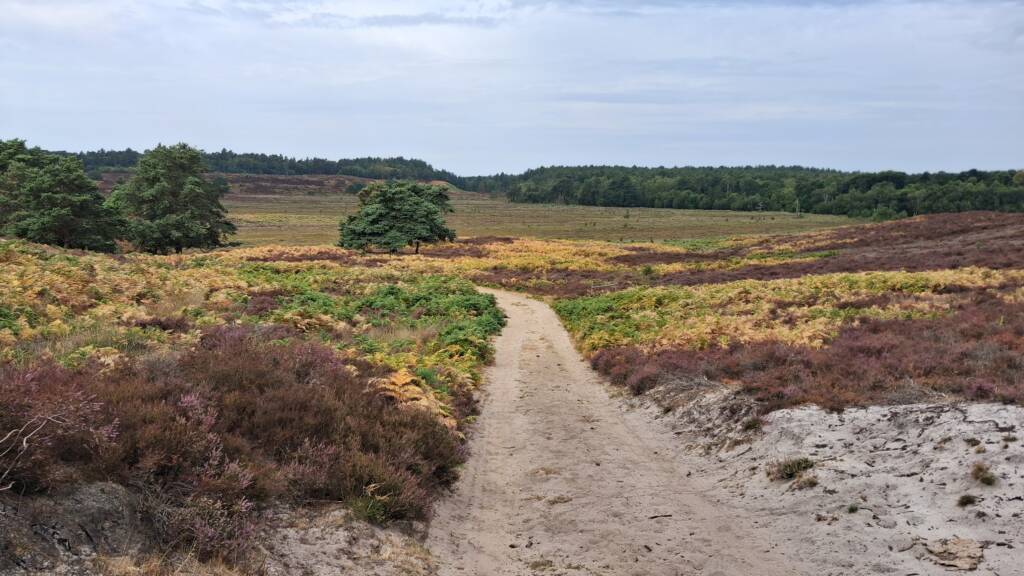
Click on an image to expand
Image Captions
The Dersingham bog that is naturally restoring.
Methodology
WP1: Bund Pool Methane Mitigation Trial
A randomized block field manipulation across newly formed contour bund pools comparing four treatments: (i) Control, (ii) Gypsum addition (sulfate-mediated methanogenesis inhibition), (iii) Sphagnum spp. inoculation, and (iv) Gypsum + Sphagnum spp. combined. The measurements will be: gas flux chambers (diffusive 〖”CH” 〗_4/〖”CO” 〗_2), funnel trap arrays (ebullition monitoring), and porewater chemistry (〖”SO” 〗_4^(2-), “S” ^(2-), dissolved organic carbon).
WP2: Baseline Tree-Mediated Fluxes & CARBINE Benchmarking
Quantification of stem and soil 〖”CH” 〗_4 emissions across intact and clearfell-adjacent forestry blocks on peat. Measurements will be based on custom stem chambers on key forestry species (e.g., Picea sitchensis, Pinus contorta); continuous water table depth (WTD); soil temperature; peat depth; and topographic position measurement. Empirical flux totals will be compared to CARBINE-simulated baselines across environmental gradients.
WP3: Area of Effect (AoE) Hydrological & Flux Dynamics
Evaluation of spatial drawdown and re-wetting gradients adjacent to interventions using a dual approach. Spatial transects extending perpendicular from contour bunds constructed across a 5+ year age gradient. A BACI (Before-After-Control-Impact) approach will be used on chosen transects. Monitored transects will be installed across scheduled annual bunding sites to capture immediate post-construction ecohydrological shifts. High-resolution automated WTD piezometer transects, spatial chamber flux mapping, and vegetation recovery metrics will be used to derive empirical buffer distances relative to Peatland Code standards.
Project Timeline
Year 1
Focus: Experimental design, site instrumentation, baseline measurement, and pre-treatment data collection across active forest-to-bog (F2B) restoration sites.
Key Tasks:
Complete literature review and select field sites containing both 5+ year chronosequence bunds and upcoming annual bunding blocks.
Construct custom stem-flux chambers and deploy high-resolution automated water table depth (WTD) piezometer transects for the Before-After-Control-Impact (BACI) study (WP3).
Establish baseline soil and stem 〖”CH” 〗_4/〖”CO” 〗_2 flux measurements across species (Picea sitchensis, Pinus contorta), slopes, and peat depths (WP2).
Delineate experimental bund pools, measure pre-treatment baseline ebullition and diffusion gas fluxes, and sample baseline porewater chemistry (WP1).
Year 2
Focus: Execution of the pool methane mitigation trial, full-season stem emission monitoring, and post-restoration ecohydrological tracking.
Key Tasks:
Apply gypsum (〖”CaSO” 〗_4⋅2″H” _2 “O” ) and Sphagnum cuspidatum inoculants to target bund pools and initiate bi-weekly monitoring of ebullitive/diffusive gas fluxes and porewater chemistry (WP1).
Conduct intensive seasonal sampling campaigns (winter, spring peak, summer peak) measuring tree stem emissions, sap flow, soil temperature, and WTD with a portable cavity ring-down spectrometer (WP2).
Monitor immediate post-bunding hydromorphic shifts on new BACI sites and conduct spatial flux mapping and vegetation surveys along the 5+ year chronosequence transects (WP3).
Collect sediment and water cores from treated pools and extract DNA for microbial sequencing.
Year 3
Focus: Microbial sequencing analysis, process modeling (CARBINE benchmarking), spatial footprint analysis, and manuscript preparation.
Key Tasks:
• Run 16S rRNA and pmoA gene sequencing on pool samples to determine methanotroph/methanogen community responses to gypsum and Sphagnum treatments (WP1).
• Benchmark empirical stem/soil flux data against CARBINE process model simulations using Generalized Additive Models (GAMs) to evaluate emission factor accuracy (WP2).
• Calculate empirical hydromorphic and biogeochemical Area of Effect (AoE) boundaries using non-linear breakpoint regressions and compare them against Peatland Code buffer rules (WP3).
• Draft and submit Manuscript 1 (Pool Methane Mitigation) and Manuscript 2 (Stem Emissions & CARBINE Benchmarking) to peer-reviewed journals.
Year 3.5
Focus: Finalizing publications, assembling the PhD dissertation, defending the thesis, and translating findings for carbon market stakeholders.
Key Tasks:
• Draft and submit Manuscript 3 (Spatial Area of Effect and Peatland Code Buffer Refinement) for publication.
• Produce a 2-page Policy & Practitioner Briefing Document for the IUCN UK Peatland Programme and Peatland Code Technical Advisory Board.
• Assemble, write, and submit the complete PhD thesis (Introduction, 3 empirical chapters, Discussion/Policy Synthesis).
• Conduct the viva voce examination and host a stakeholder workshop to disseminate findings to land managers and carbon code developers.
Training
& Skills
• Field Hydro-Biogeochemistry: Operation of infra-red gas analysers, custom tree-stem chamber design, ebullition trap deployment, and automated hydrological piezometer arrays.
• Laboratory & Genomics: Porewater hydrochemistry (〖”SO” 〗_4^(2-), DOC) and soil organic matter analysis.
• Advanced Computation & Modeling: Non-linear statistical modeling in R (GAMs, Linear Mixed-Effects, breakpoint regression), spatial GIS mapping, and process model benchmarking against CARBINE.
• Policy & Professional Practice: Carbon market standard evaluation (Peatland Code compliance), industry knowledge exchange, high-level remote field risk management, and academic publishing.
References & further reading
Some recent relevant papers from the group:
Fearns-Nicol, E. E., F. Worrall, P. Reilly, J. L. A. Knapp, and J. Small. 2026. “ The Impact of Biochar Addition on the Water Quality of a Lowland Peat Ecosystem.” Hydrological Processes 40, no. 3: e70433. https://doi.org/10.1002/hyp.70433.
Worrall, F. and N J.K. Howden, 2025.The initiation of peat formation – The relative importance of self-weight compaction and decomposition”: https://www.sciencedirect.com/science/article/pii/S0341816225005764
Glatzel, S., Worrall, F. and G.D.Clay (2025).. Stagnation in peat profiles controls organic matter transformation in different mire types. Biogeochemistry 168, 63 https://doi.org/10.1007/s10533-025-01258-z
