

IAP-26-072
Fresh or recycled? Tracing weathering, carbon, and clay formation in shale landscapes from the Alps to the Andes
Over millions of years, rock weathering regulates Earth’s climate. Silicate minerals consume atmospheric carbon dioxide (CO2) as they weather, converting it to bicarbonate that is ultimately stored in marine carbonate minerals. Shales, which underlie up to a quarter of the land surface, complicate this picture. They contain pyrite (iron sulfide) and ancient organic carbon, which oxidise once exposed by erosion: organic carbon releases CO2 directly, and pyrite forms sulfuric acid that releases CO2 from carbonate minerals, both reactions consuming oxygen (Hilton & West, 2020). Whether eroding shale landscapes are net sources or sinks of CO2 depends on the balance between these reactions, which remains poorly constrained.
Clay minerals are the main solid product of silicate weathering, so their formation can potentially be used to reconstruct CO2 consumption from weathering. However, shales are largely made of clays formed in earlier weathering cycles, so clay in soils and rivers is a mixture of newly formed and recycled material (Dellinger et al., 2014). The two cannot currently be separated with confidence, limiting the interpretation of both modern weathering fluxes and records of past weathering.
This project combines tracers recording different parts of the weathering system. Lithium and silicon isotope ratios shift predictably when new clay forms, because the lighter isotopes are preferentially taken up by the growing clay (Opfergelt & Delmelle, 2012; Dellinger et al., 2017). Meteoric beryllium-10, produced by cosmic rays and delivered to soils by rain, is radioactive, so clay formed during the current weathering cycle can contain it whereas clay inherited from old sedimentary rocks is depleted (von Blanckenburg et al., 2012). Rare earth element patterns record which minerals have dissolved: pyrite oxidation leaves a characteristic enrichment of the middle rare earth elements in iron oxides (Bayon et al., 2020; Moizinho et al., 2026), tracing the acid that drives weathering.
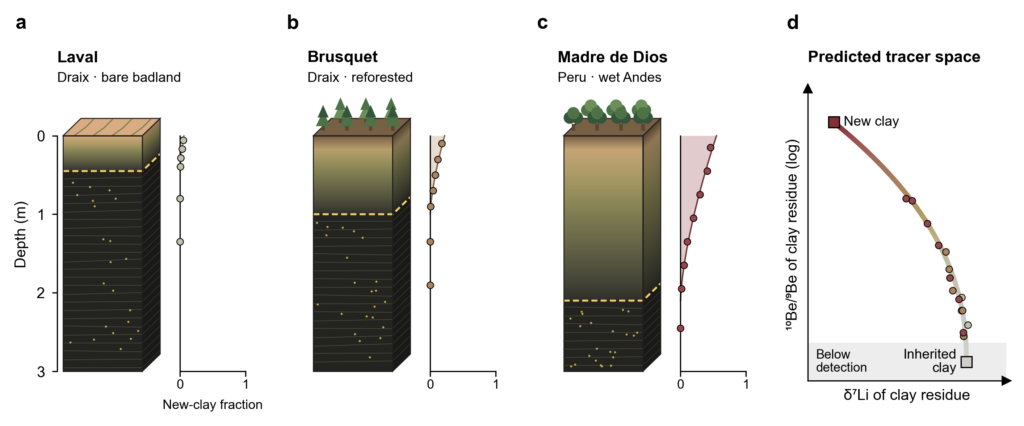
The student will work in two contrasting shale landscapes, the seasonally dry black-marl badlands of Draix in the French Alps and the persistently wet eastern Andes of Peru (Fig. 1), to address three questions:
1. Clay formation: how much new clay forms during shale weathering, and can lithium and silicon isotopes distinguish it from inherited clay, benchmarked against beryllium-10?
2. Acid sources and carbon balance: which acid-producing reactions, from pyrite and rock organic carbon oxidation to carbonic acid, drive weathering, and do they make it a net source or sink of CO2?
3. Weathering and carbon budgets: what are the long-term rates of silicate weathering, clay formation and CO2 exchange in these landscapes, and how do climate and erosion rate control them?
Click on an image to expand
Image Captions
Figure 1. Conceptual design. a–c, Schematic weathering profiles in the bare Laval and reforested Brusquet catchments (Draix, French Alps) and the wet eastern Andes (Madre de Dios, Peru); shading grades from fresh black shale to weathered regolith, and the dashed line marks the pyrite oxidation front. Beside each profile, the predicted fraction of newly formed clay with illustrative samples. d, The same samples between inherited clay (no 10Be, heavier δ7Li) and new clay (10Be-bearing, lighter δ7Li). Schematic; values are hypotheses to be tested.
Methodology
Fieldwork. The student will join the supervisory team in two campaigns at the Draix-Bléone Critical Zone Observatory, France, to sample weathering profiles from unweathered Terres Noires black marl to the surface in the bare, rapidly eroding Laval catchment and the neighbouring Brusquet catchment, reforested in the late 19th century on the same rock. The pairing separates the effect of erosion rate from lithology and climate, at sites where pyrite and organic carbon oxidation are active (Roylands et al., 2024). River sediments will be sampled downstream. Existing rock, soil and sediment samples from the Madre de Dios basin, Peru (Dellinger et al., 2023), provide the wet end-member; a Peru campaign will be added if further funding is obtained.
Clay formation (Q1). After sequential leaching of exchangeable, carbonate, Fe–Mn oxyhydroxide and organic phases, the clay-size fraction (<2 µm) will be separated and characterised by X-ray diffraction. Lithium and silicon isotopes of clays and parent rocks will be measured by MC-ICP-MS at the Durham Geochemistry Centre (Dellinger et al., 2014, Baronas et al., 2018). Meteoric 10Be/9Be will be measured through the NERC National Environmental Isotope Facility (NEIF) in the leached clay residue.
Acid sources and carbon balance (Q2). Pyrite, organic carbon and carbonate contents will be measured through each profile. Leachates will be analysed by MP-AES using an established protocol at the University of St Andrews, and rare earth elements by ICP-MS on leachates and clays: middle-REE enrichment in the oxyhydroxide fraction (Bayon et al., 2020) and parent-normalised clay patterns (Jin et al., 2017) identify the dominant acid-producing reactions. In a cross-departmental collaboration with Durham Archaeology, thin sections prepared at the NEMCAS facility will be examined by polarising microscopy and X-ray computed tomography to document clay coatings, oxidation rims around pyrite and weathering-front structure.
Weathering and carbon budgets (Q3). Mass-transfer coefficients (Jin et al., 2017) will quantify the depletion of each mineral phase. Combined with erosion rates from published sediment yields and reactive 10Be/9Be (von Blanckenburg et al., 2012), these give fluxes of silicate weathering, clay formation and CO2 release from pyrite and organic carbon oxidation for each setting, with Monte Carlo uncertainty propagation.
External collaboration. Dr Mathieu Dellinger (EDYTEM, CNRS / Université Savoie Mont Blanc, France) will co-supervise the fieldwork and Li isotope work and will host a lab visit in Year 2; soil scientist Dr Jérôme Poulenard (EDYTEM) will advise on regolith profile sampling, analysis, and interpretation. Fieldwork will be coordinated with the Draix-Bléone Critical Zone Observatory team.
Project Timeline
Year 1
Literature review; training in clean-laboratory methods, sequential extraction and clay separation. Reconnaissance and main field campaigns at Draix with the supervisory team. Sample preparation, XRD, carbon and sulfur analyses and thin sections, including an inventory of the Madre de Dios archive. NEIF application prepared with the supervisors.
Year 2
Leachate analyses at St Andrews. Lab visit to EDYTEM for lithium isotope training. Rare earth element, lithium and silicon isotope analyses at Durham. Preparation of 10Be samples. Peru fieldwork, if funded. First manuscript drafted (clay formation and acid sources at Draix); results presented at a UK conference (GGRiP).
Year 3
10Be results, additional rare earth element, lithium and silicon isotope analyses at Durham. Calculation of weathering rates and carbon budgets for both settings. First manuscript submitted; second drafted (weathering and carbon budgets in dry and wet shale landscapes). Results presented at the an international conference (Goldschmidt / EGU).
Year 3.5
Second manuscript submitted. Thesis writing and submission.
Training
& Skills
Training programme components include:
• Fieldwork: description and sampling of weathering profiles and river sediments in mountain terrain, working alongside the supervisory team; risk assessment and international field planning.
• Laboratory: clean-laboratory chemistry, sequential extraction, clay separation, X-ray diffraction, soil micromorphology, MP-AES, ICP-MS, MC-ICP-MS isotope analysis (Li, Si) and cosmogenic nuclide sample preparation.
• Data analysis: geochemical mass balance, isotope fractionation and Monte Carlo modelling, scientific programming (Python or R).
• Transferable skills: scientific writing and publication, conference presentation, facility and funding applications, international collaboration (EDYTEM lab visit), and the Iapetus cohort training programme. These skills apply to research, geological surveys, environmental consultancy and carbon accounting.
References & further reading
Baronas, J.J. et al. (2018). Earth and Planetary Science Letters 503, 194–215. https://doi.org/10.1016/j.epsl.2018.09.022
Bayon, G. et al. (2020). Chemical Geology 553, 119794. https://doi.org/10.1016/j.chemgeo.2020.119794
Dellinger, M. et al. (2014). Earth and Planetary Science Letters 401, 359–372. https://doi.org/10.1016/j.epsl.2014.05.061
Dellinger, M. et al. (2017). Geology 45, 411–414. https://doi.org/10.1130/G38671.1
Dellinger, M. et al. (2023). PNAS 120, e2306343120. https://doi.org/10.1073/pnas.2306343120
Hilton, R.G. & West, A.J. (2020). Nature Reviews Earth & Environment 1, 284–299. https://doi.org/10.1038/s43017-020-0058-6
Jin, L. et al. (2017). Chemical Geology 466, 352–379. https://doi.org/10.1016/j.chemgeo.2017.06.024
Moizinho, G.R. et al. (2026). Chemical Geology, 123308. https://doi.org/10.1016/j.chemgeo.2026.123308
Opfergelt, S. & Delmelle, P. (2012). Comptes Rendus Geoscience 344, 723–738. https://doi.org/10.1016/j.crte.2012.09.006
Roylands, T. et al. (2024). Earth Surface Dynamics 12, 271–299. https://doi.org/10.5194/esurf-12-271-2024
von Blanckenburg, F., Bouchez, J. & Wittmann, H. (2012). Earth and Planetary Science Letters 351–352, 295–305. https://doi.org/10.1016/j.epsl.2012.07.022
