

IAP-26-019
Why stop feeding? – The genomic basis of parasitism loss in an ancient vertebrate
Throughout the tree of life, individuals within the same species sometimes follow completely different paths through life. Yet how are these alternative life histories maintained by evolution and what genes control them?
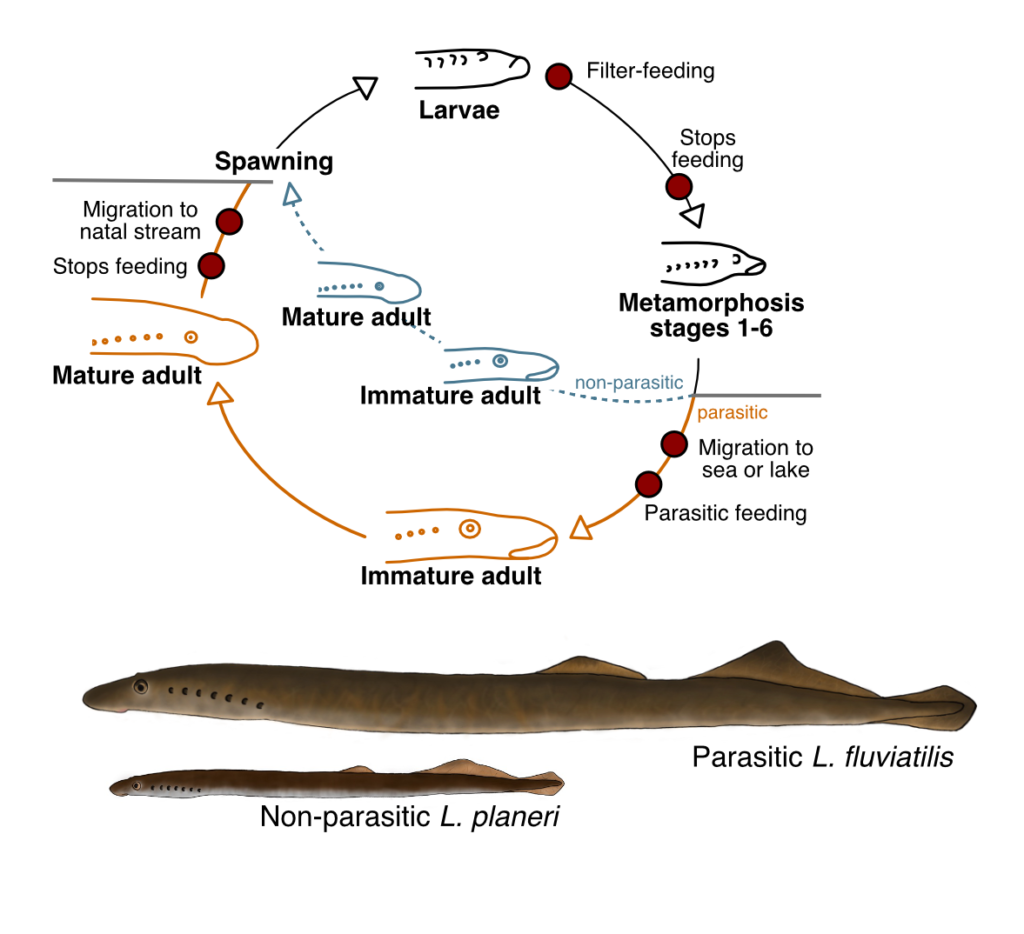
This PhD project will investigate these fundamental questions using one of the most remarkable vertebrates on Earth: the lamprey. Lampreys are ancient jawless fishes that have existed for over 500 million years and exhibit striking differences in lifestyle. Some individuals migrate to the sea or large lakes, where they feed parasitically on other fish before returning to freshwater to reproduce. Others remain in freshwater throughout their lives, never feed as adults, and reproduce shortly after metamorphosis. Despite these dramatic differences, the two forms are indistinguishable during their larval stage and can still interbreed. This creates a unique natural experiment that allows us to investigate how evolution generates and maintains alternative life histories within species.
Recent research suggests that key genetic differences between lamprey life-history forms are concentrated in a small number of regions of the genome, including large structural variants. Intriguingly, hybrid individuals are common among larvae but much rarer among adults, suggesting that natural selection may act differently across life stages. However, the genetic and developmental mechanisms underlying these patterns remain largely unknown.
This project will build on an ongoing NERC-funded programme in the laboratory and combine field ecology, evolutionary biology, genomics, and bioinformatics to understand how alternative life histories evolve. The student will work with wild lamprey populations and use cutting-edge sequencing technologies to address questions such as:
• Which regions of the genome control major differences in migration, feeding strategy, and reproduction?
• How do hybrids differ from their parental forms in growth, development, and life-history traits?
• How does natural selection act on individuals at different stages of their life cycle?
• How can alternative life histories persist despite ongoing interbreeding?
The project will provide training in a wide range of highly transferable skills, including field sampling, genomic data analysis, bioinformatics, population genetics, statistical modelling, and evolutionary theory. The student will become part of a collaborative research environment and contribute to internationally significant research addressing one of the central questions in evolutionary biology: how biodiversity is generated and maintained. This project has a high likelihood of resulting in high-profile and high-impact publications since it i) addresses fundamental questions in evolutionary biology using a fascinating study system, ii) makes use of state-of-the-art ‘omics and computational approaches, and iii) benefits from an expert supervisory team.
By combining a fascinating study system with state-of-the-art genomic approaches, this project offers an exciting opportunity to make novel discoveries and develop expertise at the interface of ecology, evolution, and genomics.
Click on an image to expand
Image Captions
Alternative life-histories in lampreys, with depictions of a parasitic and non-parasitic lamprey.
Methodology
This PhD project combines field ecology, evolutionary biology, genomics and bioinformatics to investigate how alternative life histories evolve and persist in natural populations.
The student will undertake fieldwork in two well-characterised lamprey hybrid zones: the Loch Lomond catchment in Scotland and the River Oir in France. Working alongside the supervisory team and collaborators, the student will collect lampreys representing different life-history forms and their hybrids across multiple life stages. These populations provide a unique opportunity to study evolution in action because individuals with contrasting lifestyles still interbreed in the wild.
The student will examine how traits linked to reproduction, growth and development vary between life-history forms and hybrids. These phenotypic data will be combined with genomic information to investigate how genetic variation influences key life-history traits.
A major component of the project will involve analysing genome sequencing data to identify the genetic factors associated with differences in feeding strategy, migration and reproduction. The student will work with extensive existing genomic resources, including whole-genome sequencing data and high-quality reference genomes, while also generating new data from field-collected samples. Particular emphasis will be placed on understanding the role of large-scale genomic variation, identifying genomic regions under natural selection, and linking genetic differences to variation in phenotype.
The project will provide training in a wide range of highly transferable skills, including field sampling, molecular ecology, bioinformatics, population genomics, statistical modelling and data science. The student will work closely with an interdisciplinary supervisory team and gain experience applying cutting-edge genomic approaches to address fundamental questions in evolutionary biology.
Project Timeline
Year 1
• Literature review and project development.
• Training in bioinformatics, genomics and evolutionary biology through courses, workshops and the supervisory team.
• Fieldwork in Scotland and/or France to collect lampreys from natural populations.
Year 2
• Phenotypic analyses of life-history, growth and reproductive traits.
• Molecular laboratory work and genome sequencing.
• Analysis of genomic data to identify genetic differences associated with alternative life histories.
• Development of computational and statistical skills for analysing large biological datasets.
Year 3
• Advanced genomic and evolutionary analyses.
• Integration of genetic and phenotypic data.
• Preparation of scientific manuscripts and presentation of results at national and international conferences.
Year 3.5
• Completion of data analysis and thesis writing.
• Publication of research findings.
• Dissemination of results through conferences, seminars and outreach activities.
Training
& Skills
The student will receive training from an interdisciplinary team of internationally recognised researchers working at the interface of ecology, evolution and genomics. The project will provide opportunities to develop expertise in:
• Evolutionary biology and ecology.
• Field sampling and phenotypic data collection.
• Molecular biology and genome sequencing.
• Bioinformatics and population genomics.
• Statistical analysis and data science.
• Scientific writing, communication and research leadership.
The student will also develop highly transferable skills in experimental design, quantitative analysis, critical thinking, project management, and oral and written communication through the University of Glasgow’s excellent postgraduate training programmes.
Based at the University of Glasgow, the student will join a vibrant and collaborative research community with strengths spanning biodiversity, evolutionary biology and quantitative genomics. The project includes opportunities for international collaboration and research visits, including fieldwork and knowledge exchange with collaborators in France, as well as interactions with researchers at the University of St Andrews.
The combination of field ecology, cutting-edge genomics and advanced data analysis will provide excellent preparation for careers in academia, conservation, environmental consultancy, biotechnology, government research, and the rapidly growing data science sector.
References & further reading
European lamprey system:
Jacobs et al. “A mosaic of genomic architectures underpins parasitism loss in a jawless vertebrate”. bioRxiv doi: https://doi.org/10.64898/2026.05.11.724254.
Evans et al. “The evolution of lamprey (Petromyzontida) life history and the origin of metamorphosis.” Reviews in Fish Biology and Fisheries 28.4 (2018): 825-838.
Hume et al. “RADseq and mate choice assays reveal unidirectional gene flow among three lamprey ecotypes despite weak assortative mating: Insights into the formation and stability of multiple ecotypes in sympatry.” Molecular Ecology 27.22 (2018): 4572-4590.
Rougemont et al. “Inferring the demographic history underlying parallel genomic divergence among pairs of parasitic and nonparasitic lamprey ecotypes.” Molecular ecology 26.1 (2017): 142-162.
Structural genetic variation:
Akopyan & Jacobs et al. (2026) Multiple chromosomal inversions modulate continuous local adaptation along a steep thermal cline. Science 391 (6789), 1015-1021.
Mérot et al. “A roadmap for understanding the evolutionary significance of structural genomic variation.” Trends in Ecology & Evolution 35.7 (2020): 561-572.
Wellenreuther, Maren, et al. “Beyond supergenes: the diverse roles of inversions in trait evolution.” Trends in Ecology & Evolution (2025).
