

IAP-26-111
Privacy-Preserving AI for Assessing UK Data Centre Water Demand
The rapid growth of AI and other digital services is driving data centre development across the UK, and planning for this growth requires a clear understanding of its water needs. Many sites use water for cooling, and their demand rises in hot weather, when supplies are under most strain. Global Action Plan reports that 84% of proposed water-intensive developments are in areas already under water stress or expected to be by 2040. Planners therefore need evidence of how much water these sites use, and how this will change as computing demand grows.
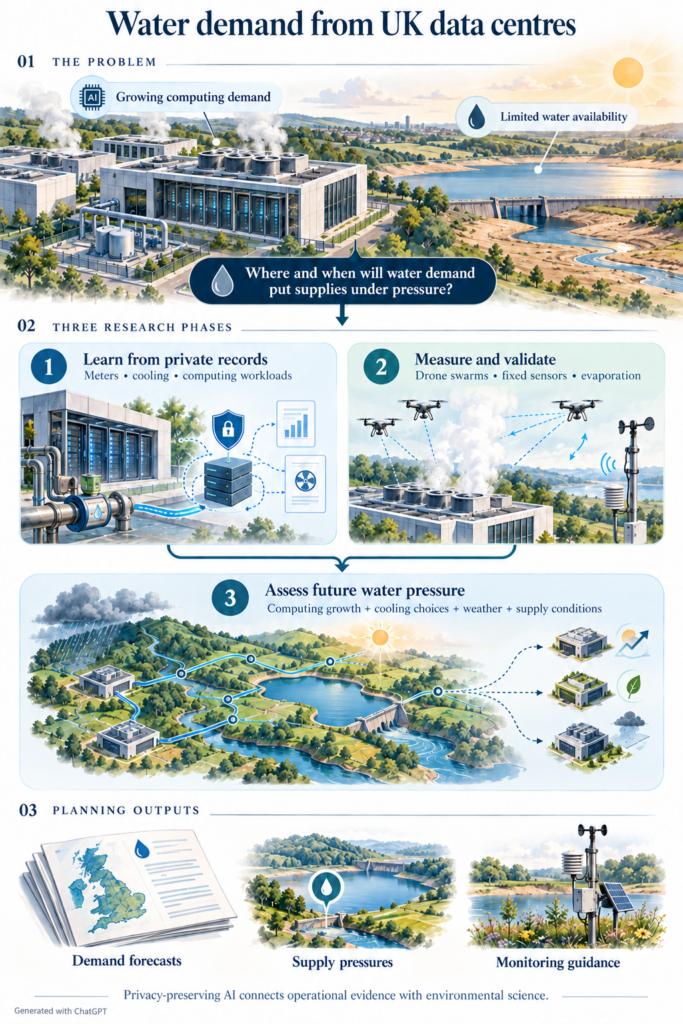
This PhD will provide that evidence by investigating how weather, cooling technology and computing demand shape water use at UK data centres, and the resulting pressures on supplying water systems. Meter readings show how much water a site receives, but not how much evaporates, so the project will combine them with environmental measurements of evaporative loss. It will establish how these losses respond to weather, how the response differs between cooling systems, and how growth in computing demand could alter seasonal water pressures, using models to explore future demand and its uncertainty.
The records needed to explain this demand are, however, confidential: detailed cooling and workload data reveal commercially sensitive operating patterns. Privacy-preserving AI can allow participating organisations to analyse them jointly without sharing raw data. The project will quantify how far combining confidential records with environmental observations improves water-use estimates and forecasts, and when these gains are greatest, informing water companies, regulators and regional planners.
Click on an image to expand
Image Captions
Overview of the project’s environmental problem, three research phases and planning outputs. Image generated with ChatGPT.
Methodology
The work follows three connected strands, moving from operational records to field measurement and then to the water systems supplying each site. First, the student will assess available meter, cooling and workload records, align them by site and time, and develop forecasting models that account for weather and cooling technology. As these records cannot simply be pooled, federated learning will be investigated, with secure multi-party computation and differential privacy assessed against defined confidentiality requirements. Models will be compared with simpler statistical and physical approaches for accuracy, uncertainty and privacy cost, and tested on periods and sites withheld from development. AI workloads will be examined where suitable records exist. Measurements from the second strand will validate the link between cooling conditions and water use, which connects future computing scenarios to water demand.
Second, the student will measure evaporation directly. Fixed sensors and coordinated drone swarms will record humidity, temperature and wind around suitable evaporative cooling systems. Simultaneous observations at several positions will separate spatial variation from changes over time, supporting mass- and energy-balance estimates. Controlled experiments with known water losses will establish accuracy and uncertainty before field deployment. Evaluation will account for sensor response, background conditions and drone airflow, and quantify what swarms add in accuracy and coverage over fixed sensors and sequential single-drone sampling.
Fieldwork will focus on a small number of consenting sites, chosen for cooling technology, access and measurement feasibility. Operator records will support validation, with secure comparisons where needed, and satellite observations may help characterise sites. Access to operators and water companies will be sought, but no external partnership or placement is assumed.
Third, the student will place these results in their hydrological context, identifying the sources and supply zones serving participating sites and relating the timing and scale of cooling demand to seasonal and drought-related limits on water availability. HadUK-Grid weather observations and National River Flow Archive records will support this analysis, with river flows used where relevant to actual supplies. Future scenarios will draw on forecasts of AI and other digital services, planned capacity and computing efficiency, linking computing demand to cooling and water demand under different weather and cooling technologies, without assuming proportional growth. Results will distinguish potential supply pressure from demonstrated environmental effects.
Project Timeline
Year 1
The first year will lay the foundations. The student will review the environmental and privacy literature, define research questions and data requirements, assess access to records and sites, and complete relevant training. Baseline models will be developed, sensors calibrated in controlled experiments, confidentiality requirements established and fieldwork approvals obtained. By the end of the year, the student will have a defined study design, an initial data inventory, baseline forecasts and a calibrated measurement approach with quantified uncertainty.
Year 2
The second year moves into the field. Where access permits, targeted campaigns will sample selected cooling systems with simultaneous drone measurements across contrasting weather and operating conditions, and results will be compared with known or independently recorded water losses. In parallel, the student will develop the privacy-preserving models, quantify how environmental observations reduce uncertainty, and assemble weather and hydrological records for supplying sources. Outputs will be a documented measurement dataset, validated evaporation estimates and initial models combining operational and environmental evidence.
Year 3
The third year completes fieldwork and validation and turns to the wider picture. The student will assess seasonal and drought-related demand and develop scenarios linking computing demand, planned capacity and efficiency to cooling needs and water use, exploring plausible ranges rather than a single forecast. Uncertainty, and the benefits and limitations of additional measurements and privacy protection, will be quantified, and papers and thesis chapters drafted. Outputs will include an assessment of seasonal supply pressures and guidance on the measurements and confidential data most useful for planning.
Year 3.5
The final six months will bring the work together: completing analysis, finalising publications and submitting the thesis within the funded period, with no essential fieldwork deferred. Reusable code and shareable data products will be consolidated, subject to confidentiality agreements, and a concise stakeholder briefing will explain the practical implications and uncertainties for practitioners.
Training
& Skills
Training will span environmental science and computing. Environmental training will cover field measurement, evaporation and atmospheric transport, hydrological analysis, uncertainty assessment and reproducible data analysis; computational training will cover machine learning, privacy-enhancing technologies and applied cryptography. Drone training will cover coordinated sampling, sensor integration and university and CAA rules. Practical work will build experience in experimental design, field calibration and linking physical measurements to statistical models, alongside research communication and responsible management of sensitive data. Training will be tailored to the student’s background, with early emphasis on complementary skills, and supported by the supervisors and the Iapetus cohort programme.
Applicants from environmental science, engineering or computer science with strong quantitative skills are welcome. Experience with drones or applied cryptography would be an advantage, and training will develop the complementary skills required. If access to records or flights is limited, controlled experiments, fixed sensors and public data will allow the research to continue.
References & further reading
[1]. Global Action Plan. Data centre proposals and water stress (2026).
https://www.globalactionplan.org.uk/latest/news/report-reveals-majority-of-new-data-centres-planned-for-water-stressed-areas
[2]. UK Government. Data centres designated critical national infrastructure (2024).
https://www.gov.uk/government/news/data-centres-to-be-given-massive-boost-and-protections-from-cyber-criminals-and-it-blackouts
[3]. Environment Agency. National Framework for Water Resources 2025, section 9.
https://www.gov.uk/government/publications/national-framework-for-water-resources-2025-water-for-growth-nature-and-a-resilient-future/9-taking-action-on-other-significant-water-using-sectors-and-emerging-demands
[4]. Met Office. HadUK-Grid datasets.
https://www.metoffice.gov.uk/research/climate/maps-and-data/data/haduk-grid/datasets
[5]. UKCEH. National River Flow Archive API.
https://nrfa.ceh.ac.uk/data/use-nrfa-data/nrfa-api
