

IAP-26-126
Rethinking Recreational River Water Quality: A Catchment-Scale Modelling Approach
The recreational use of rivers has increased substantially across the UK over the past decade, driven by growing participation in open-water swimming, paddle sports and other nature-based recreation. This has coincided with increasing public concern regarding river water quality and a rapid expansion in the number of inland bathing water designations. While this represents an important shift in water resource management and public engagement with freshwater ecosystems, it also highlights significant gaps in our understanding and ability to assess and manage microbial health risks in dynamic river environments.
Current bathing water assessment frameworks have largely evolved from decades of research in coastal and marine environments. Rivers differ fundamentally from these systems, with microbial water quality influenced by complex interactions between wastewater discharges, agricultural runoff, wildlife, sediment mobilisation, rainfall, catchment characteristics and rapidly changing flow conditions. These processes can generate substantial spatial and temporal variability in microbial contamination, often over timescales of hours rather than days. Regulatory monitoring, which relies primarily on periodic measurements of faecal indicator organisms (FIOs), such as E. coli and intestinal enterococci, may therefore fail to capture short-lived pollution events associated with rainfall, high flows and intermittent discharges.
There is a need for improved approaches that can account for the spatial and temporal variability of microbial contamination and provide a more informed assessment of recreational water risk. SCIMAP-FIO provides a spatial risk-based modelling framework for assessing the potential risk of FIO contamination across river catchments. However, its application to recreational river water quality presents opportunities for further development, particularly in improving how microbial sources, hydrological conditions and temporal variability are represented within the framework of this risk-based model.
This PhD will develop and advance SCIMAP-FIO as a tool for assessing microbial risk in river catchments and inland bathing waters. The research will combine model development with field observations and targeted monitoring to improve understanding of the factors controlling microbial risk and to test the model under a range of catchment and hydrological conditions. The improved framework will provide a more robust and spatially explicit approach to assessing recreational water quality risk and could support more targeted monitoring and management of river bathing waters, particularly during periods of elevated rainfall and changing climate conditions.
Aim: To extend the SCIMAP-FIO risk-based modelling framework to incorporate human-derived sources and temporal variability, and to improve the assessment of microbial risk at inland bathing waters.
Objectives
1. Evaluate the current SCIMAP-FIO framework and quantify the contribution and spatial distribution of agricultural and human-derived sources of FIO risk within selected river catchments.
2. Extend SCIMAP-FIO to incorporate human-derived sources, including wastewater treatment works, combined sewer overflows and septic systems, within its existing hydrological connectivity and relative-risk framework.
3. Develop a semi-dynamic representation of microbial risk by incorporating temporal variation in source inputs and hydrological conditions, and evaluate the influence of key uncertainties in source data, connectivity and risk propagation.
4. Test and apply the enhanced SCIMAP-FIO framework using targeted monitoring and existing environmental datasets to assess microbial risk at inland bathing waters and determine how modelling can complement conventional regulatory monitoring.
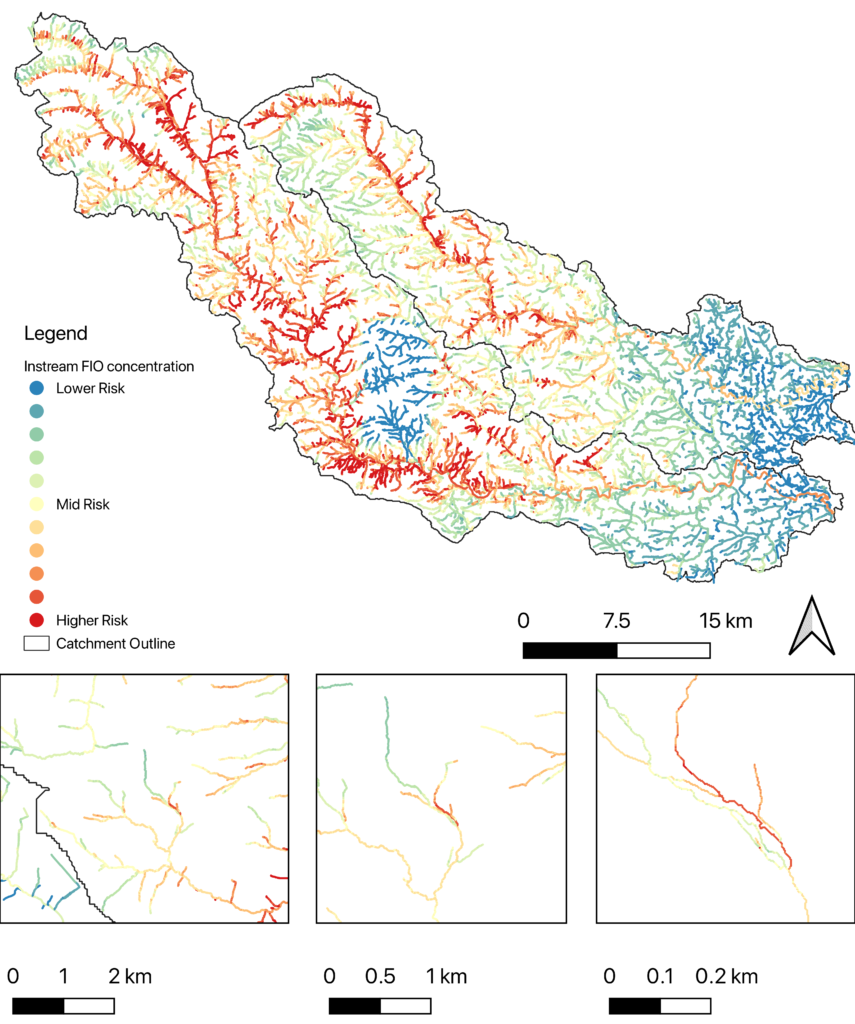
Click on an image to expand
Image Captions
Example SCIMAP-FIO output
Methodology
The PhD will build on the existing SCIMAP-FIO risk-based framework, which currently focuses primarily on agricultural sources of E. coli risk and propagates relative risk through the landscape according to hydrological connectivity. A central component of the research will be to extend this framework to incorporate human-derived sources of faecal contamination, including wastewater treatment works, combined sewer overflows (CSOs) and septic systems. This will provide a more holistic representation of the sources contributing to microbial risk at inland bathing waters.
The research will first investigate how human-derived sources can be incorporated within the existing SCIMAP-FIO framework. Point and near-point sources will be represented within the drainage network and assigned relative risk weightings based on factors such as discharge magnitude, frequency and treatment performance. Their contribution to downstream risk will then be propagated using the existing connectivity framework, with consideration of dilution and attenuation through the river network. This will require development of approaches for translating information between catchment, river and sewer network representations while retaining the relative-risk basis of SCIMAP-FIO.
A key challenge will be introducing temporal variability into a predominantly static risk framework. The research will investigate how source activation and magnitude can be linked to environmental and operational drivers. For example, CSO risk could be conditioned on rainfall and catchment wetness, wastewater inputs on treatment performance and discharge conditions, and septic system contributions on location and failure likelihood. This will allow the model to move towards a semi-dynamic representation of microbial risk while retaining the computational and spatial advantages of the existing SCIMAP-FIO approach.
Model development will be supported by targeted field monitoring in selected river catchments. Sampling will focus on locations and periods where human-derived sources are expected to have an important influence, including rainfall and high-flow events. Measurements of FIOs will be combined with rainfall, river flow and available information on wastewater infrastructure and catchment characteristics. Existing regulatory and environmental datasets will provide additional observations for model evaluation. These data will be used to test assumptions about source contributions, timing and downstream propagation, and to identify where uncertainty in source data has the greatest influence on predicted risk.
The enhanced SCIMAP-FIO framework will then be evaluated against independent observations across contrasting catchment and hydrological conditions. Model sensitivity and uncertainty analysis will be used to assess the influence of uncertain source locations, source weightings, activation thresholds and attenuation assumptions. Particular attention will be given to whether incorporating human-derived sources and temporal variability improves the model’s ability to identify periods and locations of elevated microbial risk, rather than simply increasing model complexity.
Finally, the improved framework will be applied to inland bathing waters to investigate how different pollution sources contribute to recreational water risk and how this risk changes under different hydrological conditions. Scenario analysis will explore the potential consequences of rainfall-driven pollution events and other episodic inputs, as well as the implications of changing patterns of extreme rainfall. The research will ultimately establish how SCIMAP-FIO can be developed from a predominantly agricultural, static risk mapping framework towards a more holistic and semi-dynamic assessment of microbial risk from both agricultural and human sources.
This combination of model development, targeted monitoring and uncertainty analysis will provide both a practical improvement to SCIMAP-FIO and new insight into the sources and conditions driving microbial risk in recreational rivers.
Project Timeline
Year 1
In the first 4 months of the studentship you will develop a critical review of the literature. After engaging with the literature, you will begin to learn key skills in catchment risk mapping and visualisation and identify key training opportunities.
Year 2
In year 2 you will undertake a spatially-targeted catchment sampling. You will be encouraged to begin to draft chapters as you progress.
Year 3
In addition to writing up aspects of the research undertaken so far, you will evaluate the influence of key uncertainties in source data, connectivity and risk propagation. You will investigate the impact of future landscape/climate change scenarios on inland bathing water quality.
Year 3.5
The final 6 months will be used to interpret the outputs from the scenario modelling and to finalise the thesis with respect to writing up and refining further the drafts of chapters completed thus far.
Training
& Skills
This studentship will provide a platform to build an interdisciplinary research career in environment and health, with a focus on catchment microbial dynamics. The studentship will broaden the scope of the applicant’s skills base by providing specialist training in the safe handling of Hazard Group 2 microorganisms & microbiological methods, fieldwork sampling and monitoring techniques and GIS modelling approaches, including computer code writing and risk & uncertainty analysis with a focus on Python and the effective use of web-based technologies for scientific research. The student will join supportive research groups at the University of Stirling and have access to partner expertise at the Durham University. A full programme of Iapetus training courses will also be available. Finally, this studentship will provide opportunities to understand the role of the science-policy interface and experience KE-related activity.
References & further reading
https://scimap.org.uk/
