

IAP-26-013
Genomic hotspots of adaptation in wild insects
Adaptive evolution can occur surprisingly rapidly in wild populations under strong environmental pressure. However, there is uncertainty about what genomic factors enable such rapid responses. This project will test the role of mutational hotspots in Hawaiian populations of the cricket Teleogryllus oceanicus that are attacked by lethal parasitoid flies that eavesdrop on singing males.
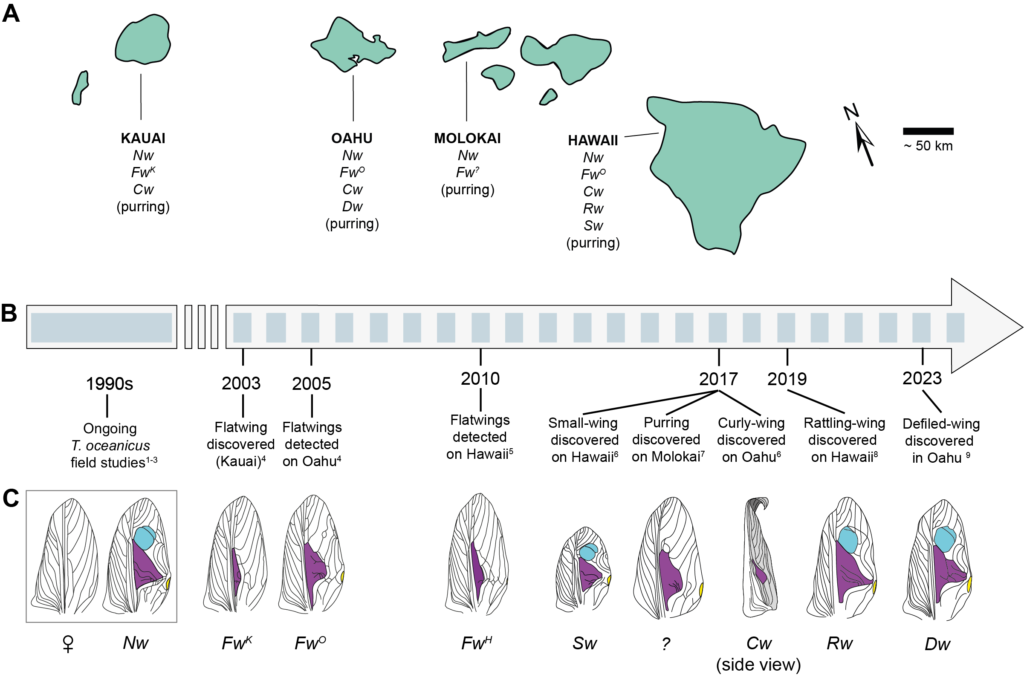
Multiple parallel adaptations have emerged in Hawaii that protect males by disrupting sound-producing structures on their wings, and different populations of crickets contain different mixes of these adaptive mutants (Fig. 1). The wing mutations have been mapped to a variety of genomic regions, in some cases involving physically close, but independent, mutations affecting the same regulatory pathways. Using a combination of gene knockdowns and morphometric, bioacoustic, and comparative genomic analyses, the PhD student will characterise genomic hotspots of adaptation in this textbook case of exceptionally rapid evolution in the wild and test the hypothesis that pre-existing genomic modules related to wing development enhance evolvability.
The project is supervised by Profs Nathan Bailey and Michael Ritchie at the University of St Andrews and includes a secondment with collaborators Drs Jelle Boonekamp and Arne Jacobs at the University of Glasgow.
Click on an image to expand
Image Captions
Figure 1. (A) Crickets in Hawaii evolved multiple independent male-silencing adaptations that disrupt sound-producing structures on their wings (blue and pink shaded areas in inset photo). (B) Parallel evolution of adaptive song reduction represents one of the fastest rates of adaptation known in the wild, and is well-characterised. (C) Candidate genomic regions have been mapped for multiple adaptive wing phenotypes, providing a basis for investigating genomic hotspots of adaptation and exploring their evolution across cricket lineages.
Methodology
1. Establish sexually dimorphic wing development gene expression networks to identify major hub and peripheral genes involved in patterning the male wing.
2. Fine-map genomic variants underlying male wing mutations above to test the hypothesis that genomic hotspots involve dysregulated network hub genes as opposed to peripheral genes.
3. Perform gene knock-down experiments (RNAi) to perturb candidate loci for adaptive wing phenotypes and validate genetic causation.
3-alt. As the student’s time and interest allow, use existing genome sequence resources to interrogate patterns of selection at genomic hotspots of adaptation across cricket lineages.
Project Timeline
Year 1
Research: Perform RNAseq experiments using developing cricket wing buds and perform gene network analyses. Training: Basic lab inductions, and (if needed) bioinformatics for transcriptomics on the high performance computing cluster. Wet-lab training for RNA extraction.
Year 2
Research: Using existing genetic mapping resources in Teleogryllus oceanicus, further fine-map and identify key candidate genes for knockdown experiments. Begin RNAi work. Training: one-month secondment to Glasgow, and practice with primer design, microinjection, and associated RNAi techniques.
Year 3
Research: Finish RNAi experiments including phenotyping knockdowns and controls. Perform comparative genomic analyses using available cricket reference genomes. Begin assembling the final thesis. Training: Comparative genomics analysis and writing workshops as needed.
Year 3.5
Complete analyses and thesis. Concurrent manuscript writing and submission will be undertaken to support the candidate’s onward career goals.
Training
& Skills
In addition to accessing Iapetus DTP training opportunities, the student will undertake ad hoc training as required by their background and interests. Opportunities include workshops addressing analysis of next generation sequencing data via the UK Crop Diversity high performance computing cluster, to which St Andrews contributes; graduate skills development courses centred on academic writing, research practice, public engagement and other topics run by the Graduate School of the University of St Andrews.
References & further reading
Rayner JG et al. (2026) Genomic signatures of adaptation across a landscape of crickets following the introduction of a parasitoid fly. Science Advances 12:eaed1906.
Bailey NW et al. (2024) Quiet but not forgotten: Insights into adaptive evolution and behavior from 20 years of (mostly) silent crickets. Advances in the Study of Behavior 56:51-87. https://doi.org/10.1016/bs.asb.2024.03.001
Zhang X et al. (2021) Rapid parallel adaptation despite gene flow in silent crickets. Nature Communications 12:50.
Vigoder FM, et al. (2016) Inducing cold-sensitivity in the frigophilic fly Drosophila montana by RNAi. PLoS ONE 11: e0165724.
Akopyan, M, et al. (2026) Multiple chromosomal inversions modulate continuous local adaptation along a steep thermal cline. Science 391, 1015-1021.
