

IAP-26-011
How to peel a slab: Insights into slab weakening and slab-plume interactions in the Afar region
Background:
Systematic geochemical trends basalts from the southern Red Sea show that the Afar mantle plume has low concentration of primordial gases such as helium (Balci et al. 2024). This suggests that the upwelling deep mantle in the plume is contaminated by oceanic crust that was subducted within the last 100 million years. The likeliest source is the Tethyan slab that is currently sinking beneath southeastern Iran (Balci et al., 2024). However, the radiogenic isotope composition, in particular Pb isotopes, of the basalts indicates the oceanic crust within the plume must be considerably older (>400 million years). Reconciling this conundrum and providing a geodynamic mechanism for supplying the regional mantle transition zone with required amounts of subducted crust remain outstanding challenges.
A clue to resolving this conundrum lies in where the plume is thought to originate within the mantle. Seismic tomography models suggest that, in contrast to many mantle plumes, the Afar plume is one of several upwelling regions originating at the mantle transition zone (Chang et al., 2016), where it has also interacted with a down going slab. Ponding of the hot, primordial volatile-rich plume at the mantle transition zone will heat the regional upper mantle and weaken the slab potentially leading to slab peeling. The anomalous Afar plume basalt geochemistry is indicative of complex slab-plume-mantle interaction that may be a consequence of the stalling of the deep sourced plume in the mid-mantle. During slab peeling, weakening at the top of the lower mantle may cause subducted slabs to lose some of their basaltic and volatile components (e.g., van Keken et al., 1996, Tauzin et al., 2024; Yu et al., 2023), providing the best current explanation for how the slab transfers geochemical signatures to the plume (Balci et al., 2024). Evidence of long-lived subduction in the Afar region suggests the regional mantle transition zone is volatile-rich and potentially basaltic-enriched. As the Afar plume journeys towards the surface it can pick up these anomalous signatures from the mantle transition zone and the present-day subducting slab thus, explaining the low helium ratios observed at the surface (Balci et al., 2024, Figure 1). However, how slabs peel off is unclear. Mineral physics and whole scale mantle convection models suggest that grain size dynamics and the presence of water may induce significant weakening at the top of the lower mantle (Dannberg et al., 2017, Mohiuddin et al., 2022, van Driel, 2022). The high incompatibility of helium during melting/metasomatism may decouple ³He/⁴He from trace elements and radiogenic isotopes in the mantle transition zone, complicating any simple interpretation of the plume’s contamination history and motivating the combined geochemical and dynamical approach taken here.
Project Objectives:
This project will use geochemical analyses of new Afar and Red Sea basalt collections to determine the number and origin of distinct mantle components in the Afar plume. Numerical modelling will then explore the slab-plume interactions incorporating water and grain-size dynamics in 2D and extended to 3D where time allows. Key research questions include:
1. Can the anomalous Afar mantle plume geochemistry be explained by entrainment of peeled-off slab material into the upwelling mantle?
2. What is the influence of grain size dynamics and the presence of water on slab weakening, and peeling at the top of the lower mantle?
3. What is the role of plume pooling at the bottom of mantle transition zone in slab weakening and peeling?
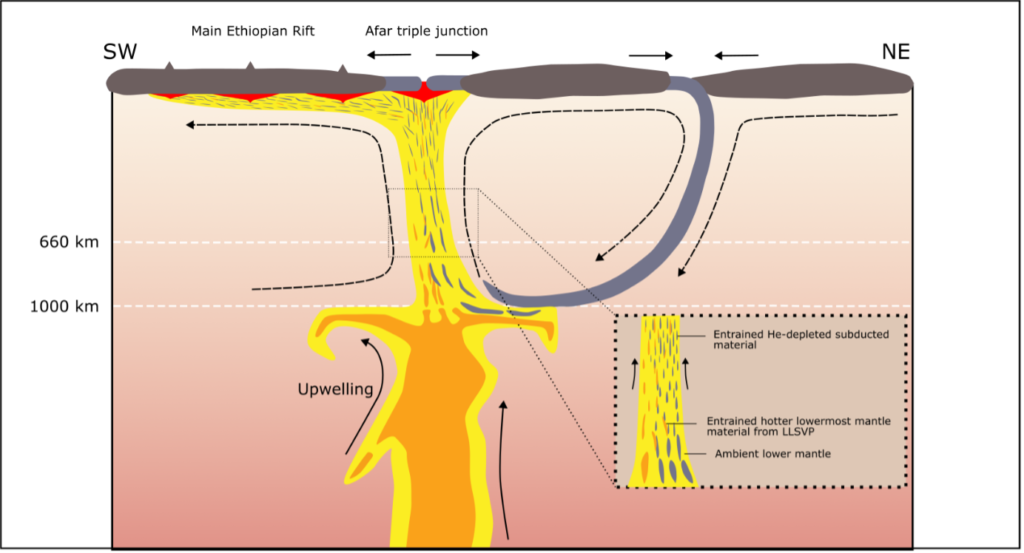
Click on an image to expand
Image Captions
Tethyan slab ‘peeling’ and uptake by the Afar plume at the top of the lower mantle could explain anomalous geochemical signatures observed in the Red Sea Basalts. From Balci et al., 2024. Image courtesy of Ugur Balci for UofG News Article)
Methodology
Trace element and He and Pb isotopes will be measured in a new suite of basaltic glass from the southern Red Sea and olivine-phyric basalts from Djibouti to constrain the contribution, nature and age of recycled slab material in the Afar plume. Where analytical capacity allows, Os isotope and highly siderophile element measurements would provide a further, independent test of the age of any recycled component.
The student will use thermo-chemical-mechanical models in the open-source finite-element code ASPECT (Heister et al., 2017) to investigate how grain-size evolution, water and plume heating influence slab weakening and peeling at the top of the lower mantle. ASPECT can represent evolving grain size and composition and track material histories using particles, making it well suited to quantifying the fate of compositionally distinct slab and plume material. Initial 2-D models will explore the conditions under which basaltic crust separates from the slab and accumulates within, or is entrained from, the mantle transition zone, before the influence of plume ponding and associated thermal weakening is investigated within the same 2-D framework. Plume ponding beneath the transition zone is dynamically plausible where the 660-km phase transition and upper-lower mantle viscosity contrasts impede plume ascent. Time permitting, selected scenarios will be extended to 3-D to assess the effects of lateral slab and plume geometry.
These models will quantify how much recycled material is available for entrainment and its residence history within the mantle transition zone. These dynamically predicted proportions will then be used in isotope and trace-element mixing calculations and compared directly with the basalt geochemistry. This will test whether the observations can be reproduced by interaction between a primordial Afar plume and recently subducted material, require an older recycled reservoir accumulated through long-lived subduction, or instead require contributions from recycled material entrained into the plume at greater mantle depths. Targeted whole-mantle models will explore the latter end-member scenario.
Project Timeline
Year 1
(1) Literature review
(2) Sample preparation and laboratory work
(3) Training in HPC techniques, modelling and data analysis
(4) Development and testing of baseline 2-D subduction models for the Afar case study, including compositionally distinct slab crust and mantle.
(5) Preliminary investigation of grain-size evolution, water content and slab weakening at the top of the lower mantle.
Year 2
(1) Couple grain-size evolution, hydration/dehydration and rheological weakening in 2-D subduction models to determine the conditions that promote slab peeling and compositional separation
(2) Introduce the Afar plume into the 2-D models to investigate how plume ponding and thermal weakening influence slab peeling and the entrainment of recycled material
(3) Systematically test the influence of key parameters (slab age, crustal thickness, water content, mantle rheology) and quantify the amount and residence history of recycled material available for plume entrainment
(4) Integrate the numerical predictions with He-Pb and trace-element mixing calculations and compare these with the Afar and southern Red Sea geochemical dataset
(5) Write and submit geochemistry paper
(6) Attend and present at an international workshop e.g., Ada Lovelace workshop on Mantle and Lithosphere dynamics
Year 3
(1) Test whether the dynamically predicted proportions and histories of recycled material reproduce the observed Afar plume geochemistry, refining the 2-D models as needed
(2) Time permitting, extend selected scenarios to 3-D to assess lateral slab and plume geometry, and/or run targeted whole-mantle end-member experiments to test whether more deeply recycled material is required
(3) Attend and present at an international conference e.g., AGU or EGU
(4) Write and submit main geodynamics/slab-plume interaction paper
Year 3.5
Completion of manuscripts for publication and thesis writing
Training
& Skills
The student will receive training in sample preparation, petrography and trace element/isotope analysis in year 1. In year 2 training will involve testing, running, processing and analysing numerical models. This will include essential skills like good programming practices (including version control), GitHub skills and usage of high-performance computing systems (HPCs)
Training in key skills (e.g., writing, networking, presentation skills, paper/thesis writing) will be provided by the College of Science and Engineering and Research and Innovation Services at the University of Glasgow, and the student will benefit from training provided by IAPETUS DTP.
The student will have opportunities to work with collaborators at the GEOMAR Helmholtz Centre for Ocean Research. The student will also have opportunities to attend national/international meetings to present research and to participate in the annual ASPECT Hackathon where they can contribute to and develop new code. We aim to see the student publish 1-2 papers in leading journals during their PhD. Upon completion, the student will be well equipped for a career in academia or in a range of industries.
References & further reading
Balci, U., Stuart, F.M., Barrat, JA., Grima, A.G., & van der Zwan, F. M. (2024) The origin and implications of primordial helium depletion in the Afar mantle plume. Communications Earth and Environment 5, 519 (2024). https://doi.org/10.1038/s43247-024-01675-2
Chang, S. J., Ferreira, A. M. G., & Faccenda, M. (2016). Upper- and mid-mantle interaction between the Samoan plume and the Tonga-Kermadec slabs. Nature Communications 7. https://doi.org/10.1038/ncomms10799
Dannberg, J., Eilon, Z., Faul, U., Gassmöller, R., Moulik, P., & Myhill, R. (2017). The importance of grain size to mantle dynamics and seismological observations. Geochemistry, Geophysics, Geosystems 18(8), 3034–3061. https://doi.org/10.1002/2017GC006944
Mohiuddin, A., ichiro Karato, S., & Girard, J. (2020). Slab weakening during the olivine to ringwoodite transition in the mantle. Nature Geoscience, 13(2), 170–174. https://doi.org/10.1038/s41561-019-0523-3
Heister, T., Dannberg, J., Gassmöller, R., & Bangerth, W. (2017). High accuracy mantle convection simulation through modern numerical methods – II: Realistic models and problems. Geophysical Journal International, 210(2), 833–851. https://doi.org/10.1093/gji/ggx195
Tauzin, B., Waszek, L., Ballmer, M. D., Afonso, J. C., & Bodin, T. (2022). Basaltic reservoirs in the Earth’s mantle transition zone. Proceedings of the National Academy of Sciences of the United States of America, 119(48). https://doi.org/10.1073/pnas.2209399119
Van Driel, J., 2022. Understanding the Role of Grain Boundaries in the Lower Mantle: From the Atom to the Continuum (Doctoral dissertation, UCL (University College London)
van Keken, P. E., Karato, S., & Yuen, D. A. (1996). Rheological control of oceanic crust separation in the transition zone. Geophysical Research Letters, 23(14), 1821–1824. https://doi.org/10.1029/96GL01594
Yu, C., Goes, S., Day, E. A., & van der Hilst, R. D. (2023). Seismic evidence for global basalt accumulation in the mantle transition zone. Science Advances, 9(22). https://doi.org/10.1126/sciadv.adg0095
Shaw, A.M., Hauri, E.H., Behn, M.D., Hilton, D.R., Macpherson, C.G. & Sinton, J.M. (2012). Long-term preservation of slab signatures in the mantle inferred from hydrogen isotopes. Nature Geoscience, 5, 224–228
Yang, J., Faccenda, M., Meyzen, C.M., Marzoli, A. & Zhao, L. (2026). Subduction legacies in the mantle transition zone modulate intraplate oceanic volcanism. Nature Communications
Douglas, D., Naliboff, J., Fraters, M.R.T., Dannberg, J., Eberhart-Phillips, D., & Ellis, S. (2025). Constraining solid dynamics, interface rheology, and slab hydration in the Hikurangi subduction zone using 3-dimensional fully dynamic models. Geochemistry, Geophysics, Geosystems, 26(6). https://doi.org/10.1029/2024GC011824
