

IAP-26-012
Enhancing conservation decision-making through scientific innovation
Global biodiversity is in crisis, with an estimated one million species at risk of extinction (IPBES 2019). Halting and reversing biodiversity loss requires a ‘whole of society’ approach, meaning government, businesses, non-governmental organisations and individual actors must all play their part in biodiversity conservation (CBD 2024). For actions from such diverse sectors of society to be positively impactful, it is essential that all actors are able to measure and set science-based targets for conservation that meaningfully contribute to reducing species extinction risk.
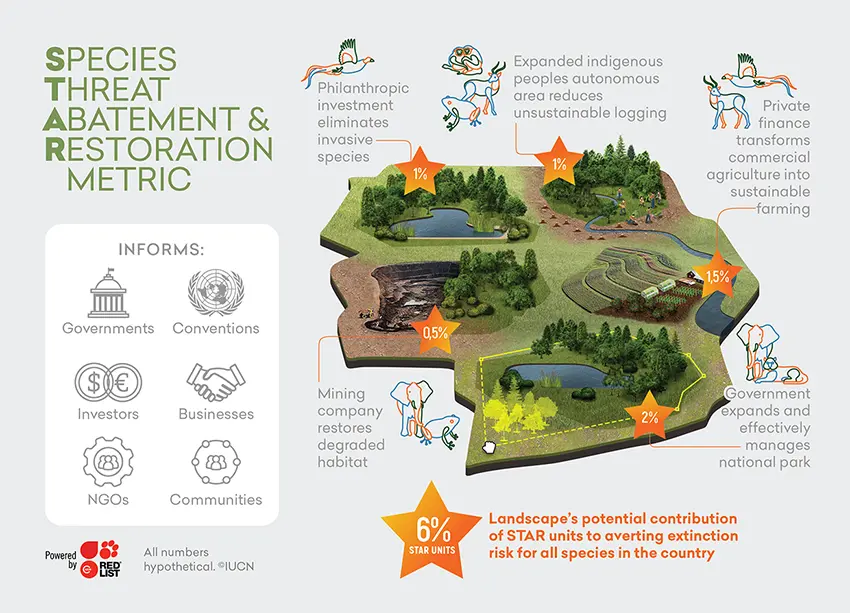
The IUCN’s Species Threat Abatement and Restoration (STAR) metric was developed to meet this need. STAR quantifies the potential species extinction risk reduction that could be achieved in a given place through the reduction of threats and restoration of habitat (Mair et al. 2021). STAR has been calculated for terrestrial amphibians, birds and mammals globally (Mair et al. 2021), with more recent work expanding the metric to the marine realm (Turner et al. 2024), while new developments will allow calculation of STAR for freshwater species (Ridley et al. in press).
STAR is integrated into IUCN’s nature positive approach to informing conservation interventions, and has been made available to businesses and government through an online portal (ibat-alliance.org). The metric is gaining traction amongst businesses, and so continued scientific development is essential to ensure that the metric keeps pace with user demands and provides the best available data for effective conservation decision making.
There are a diversity of scientific challenges that have arisen through discussions among the STAR development team (which includes IUCN, Newcastle University, Birdlife and others) and end-users. These include how migratory species should be treated in the metric, given the relative importance of different habitats and ranges to their different life history stages and the contrasting threats that may impact different parts of their range (Zurell et al. 2018). There is also a challenge with quantifying restoration potential in freshwater and marine environments, as restoration potential in STAR has so far only been quantified for the terrestrial environment (Mair et al. 2021). STAR also makes the simplistic and unrealistic assumption that threats to a species are uniformly distributed across the species’ range, yet there are increasingly spatially-explicit data available on biodiversity threats that could be used to inform more nuanced and realistic assumptions (e.g. Hansen et al. 2013). Finally, it is desirable to be able to reward actors for their past and ongoing positive conservation interventions, and STAR has the potential do achieve this, through the development of counterfactual scenarios (e.g. Grace et al. 2021).
The overall aim of this project is therefore to enhance the scientific foundations of the Species Threat Abatement and Restoration (STAR) metric to further advance its utility in conservation decision making. Project objectives are diverse to capture the range of cutting-edge scientific issues in STAR development and will provide the candidate with diverse experience and skills development. The project objectives are to:
1. Develop a novel approach that better integrates migratory species into STAR, accounting for the relative importance of different habitats and ranges for the species different life stages.
2. Test the feasibility of quantifying restoration potential in freshwater and marine environments and develop protocols where sufficient data are available.
3. Test the integration of publicly available threat data (such as global maps of rates of forest loss) into STAR, to provide spatially-explicit information on the distribution and intensity of threats.
4. Develop an approach for estimating counterfactual scenarios that would allow STAR to quantify how much lower (or higher) current extinction risk is in an area because of past and/or ongoing conservation interventions.
Click on an image to expand
Image Captions
Species Threat Abatement and Restoration (STAR) metric infographic developed by IUCN.
Methodology
Objective 1: The candidate will combine information from the scientific literature with data from sources such as the IUCN Red List to establish the availability of data that could be used to quantify the relative importance of different parts of migratory species’ ranges. Through workshops with project partners and wider collaborators, alternative approaches to integrating these data into STAR will be developed, which the candidate will then test.
Objective 2: The candidate will establish the availability of data for quantifying restoration potential in the freshwater and marine realms, and for those habitats will available data, will test the implementation of these data in the STAR metric, adapting methods from the quantification of restoration potential in the terrestrial environment.
Objective 3: The candidate will review existing global biodiversity threat data, assess the compatibility of each source with the STAR metric, and test the integration of the most suitable data into STAR for refining threat distribution and intensity.
Objective 4: Based on established methods for developing counterfactual scenarios, the candidate will work with conservation actors, identified through the project collaboration with IUCN, to establish counterfactual scenarios for real-world conservation interventions, and with input from the STAR development team, will adapt the calculation of STAR to quantify realised conservation impact.
Project Timeline
Year 1
Inception meeting between the supervisory team, candidate and colleagues from IUCN. Discussion of prioritisation of specific tasks on the project. Literature and data review on migratory species, workshops with IUCN and other collaborators to develop methods to integrate data on migratory species into STAR, and testing (chapter 1).
Year 2
Review of data availability for quantifying restoration in freshwater and marine environments, testing of approach, and workshop with IUCN and collaborators to review outcomes (chapter 2). Collation of data on biodiversity threats.
Year 3
Testing of integration of threat data into STAR (chapter 3). Workshops and meetings with conservation actors to develop counterfactual scenarios for real-world conservation interventions and quantification of impact using STAR (chapter 4). Attendance and presentation at UK and international conferences: International Congress for Conservation Biology and British Ecological Society.
Year 3.5
Write up.
Training
& Skills
The candidate will receive technical training in evidence synthesis and data visualisation, biodiversity status assessments, advanced spatial data handling and analyses of biodiversity change and threats.
The candidate will work closely with colleagues from IUCN and other collaborators located in Cambridge who are involved in STAR development, and will benefit from participation in online meetings and in-person workshops throughout the project, creating networking, professional engagement and career development opportunities. The candidate will also have the opportunity to contribute towards guidance documents aimed at policy makers and businesses, building writing and professional communication skills.
The candidate will be placed in the Modelling, Evidence and Policy research group, and will benefit from interaction with a dynamic groups of early career researchers working on diverse research topics across ecology and conservation. There will be opportunities for presentations, skills workshops and career training through the research group and wider university.
References & further reading
Convention on Biological Diversity (CBD) (2024) Introduction to the GBF. https://www.cbd.int/gbf/introduction
Grace et al. (2021) Building robust, practicable counterfactuals and scenarios to evaluate the impact of species conservation interventions using inferential approaches. Biological Conservation 261, 109259.
Hansen et al. (2013) High-Resolution Global Maps of 21st-Century Forest Cover Change. Science 342, 6160.
IPBES (2019) Global assessment report on biodiversity and ecosystem services of the Intergovernmental Science-Policy Platform on Biodiversity and Ecosystem Services. E. S. Brondizio, J. Settele, S. Díaz, and H. T. Ngo (editors). IPBES secretariat, Bonn, Germany.
Mair et al (2021) A metric for spatially explicit contributions to science-based species targets. Nature Ecology & Evolution, 5, 836–844.
Ridley et al. (in press) Mapping Area of Habitat (AOH) for inland wetland species. Conservation Biology.
Turner et al (2024) Targeting ocean conservation outcomes through threat reduction. npj Ocean Sustain 3, 4.
Zurell et al. (2018) Long-distance migratory birds threatened by multiple independent risks from global change. Nature Climate Change 8, 992-996.
